


Books Printed for the Arab Christians in the 18th Century: A Descriptive Catalog
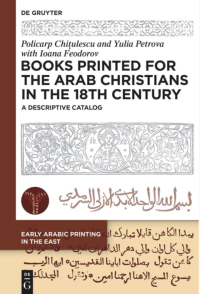
Chițulescu, Policarp and Petrova, Yulia. Books Printed for the Arab Christians in the 18th Century: A Descriptive Catalog, De Gruyter, 2026.
https://doi.org/10.1515/9783111036434
This catalog provides descriptive records of 54 Arabic books printed in Eastern Europe and the Arabic-speaking communities in the Ottoman East during the 18th century. It offers a thorough overview of the connections established through printing between the Romanian principalities and Arabic-speaking Christians in the eastern Mediterranean during this period. The catalog emphasizes the social progress that the printing culture brought to the Near East, to which Romanians made a significant contribution. The catalog also addresses the historical context of these connections and the printing activities of several prominent political and ecclesiastical figures. The books presented here are pivotal to the cultural history of the Ottoman East. They have been particularly significant in the context of conserving Byzantine-based Christianity in Arabic-speaking provinces in the region. Additionally, these books contributed to the standardization of Arabic liturgical texts and greatly influenced Christian Arabic literature. This catalog will be of interest to historians of the Arabic printed book, researchers of Arab Christian communities under Ottoman rule, as well as librarians and antiquarians because it will enable them to accurately identify and describe the 18th-century Arabic editions in their collections.
Brylov, Denys. (Un)known Islam in Ukraine: The History of Islam in the Territories of Ukraine from the Late 19th to the Early 21th Century
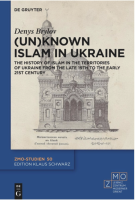
Brylov, Denys. (Un)known Islam in Ukraine: The History of Islam in the Territories of Ukraine from the Late 19th to the Early 21th Century, De Gruyter, 2026. https://doi.org/10.1515/9783112225172
With the exception of the Crimean Tatars, the history of Islam in Ukraine, often remains unnoticed. However, traces of Muslim communities have been recorded since the 8th century. Based on materials from private and state archives, as well as interviews with representatives of Muslim communities and state bodies responsible for religious policy, the book reveals the previously unknown history of Muslim communities in Ukraine since the late nineteenth century: first as part of the Russian Empire, then the Soviet Union, and after 1991 in independent Ukraine. It analyzes how Muslims have preserved, transformed, and passed on their religious identity through formal, informal, and often underground structures.
The history of these communities shows that institutionalized Islam has existed in Ukraine since the late nineteenth century, even though after 1951 it was unofficial and even underground. In independent Ukraine, the institutionalization of Islam included the emergence of Volga Tatar communities from underground, the registration of Crimean Tatar communities returning from deportation, and the emergence of communities linked to transnational Sufi and Islamist networks.
Guermantes Lailari, Dmytro Burtsev Learning from the Russia-Ukraine War: Implications for the USA, Taiwan, and China
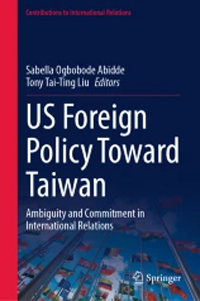
Guermantes Lailari, Dmytro Burtsev (2025) Learning from the Russia-Ukraine War: Implications for the USA, Taiwan, and China, at US Foreign Policy Toward Taiwan. Ambiguity and Commitment in International Relations. Editors: Sabella Ogbobode Abidde, Tony Tai-Ting Liu. Springer Cham. PP. 203-230.
This chapter will explore lessons from selected sources and their implications using the perspectives of USA, PRC, and Taiwan to make an informed conclusion, even though the war continues at this time (early 2025). This chapter attempts to look at the conflict strategically through the eyes of US-China-Taiwan relations. Those promoting the position that Ukraine is not connected to Taiwan (absolutely) are the PRC, Russia, and countries, groups, and individuals that tend to be pro-Russian and pro-PRC. In general, those countries promoting similarities between Ukraine and Taiwan are Ukraine, Taiwan, Japan, most former Soviet Union–occupied countries, and other countries, groups, and individuals who have been threatened or are being threatened by Russia and the PRC. The chapter concludes with some lessons that hopefully will be used to prevent a future war between Taiwan and China.
ISBN 978-3-031-80584-4
DOI:10.1007/978-3-031-80585-1_12
V. Golod. “The Dual Face of Chinese Nationalism in the Xi Jinping Era: Conflict and Peace in Xinjiang”
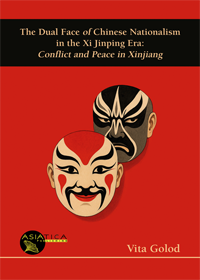
A monograph by Ukrainian China scholar Vita Golod, The Dual Face of Chinese Nationalism in the Xi Jinping Era: Conflict and Peace in Xinjiang, is now available.
The book offers a comprehensive analysis of contemporary Chinese nationalism as one of the key instruments of state governance and nation-building.
Drawing on academic literature, Chinese official sources, discourse analysis of Xi Jinping’s speeches, expert interviews, surveys, and the author’s field observations in Xinjiang, particularly in Kashgar, the monograph examines the interaction of ideology, economic policy, and ethnic governance in China under Xi Jinping.
Through the Uyghur case, the author conceptualizes Chinese nationalism as a phenomenon with “two faces”: integrative and civilizational on the one hand, disciplinary and assimilationist on the other. The book assesses the implications of this duality for stability, the unity of the “Chinese nation,” the transformation of ethnic minority identities, particularly Uyghur identity, and the prospects for peace in Xinjiang.
The table of contents and ordering information are available on the Oldi+ website.
Publisher: Asiatica, 2026. — 430 p.
ISBN: 978-617-8310-13-4
29th A. Krymskyi Annual Memorial Conference on Oriental Studies. Information letter
National Academy of Sciences of Ukraine
A. Krymskyi Institute of Oriental Studies
Dear colleagues!
We kindly invite academicians and lecturers, postgraduate and master’s degree students to participate in the 29th A. Krymskyi Annual Memorial Conference on Oriental Studies, dedicated to the 100th anniversary of the founding of the All-Ukrainian Learned Association of Oriental Studies.
The conference will be held on June 25–26, 2026.
Discussion panels are planned to cover the following issues:
- To the 100th Anniversary of the Founding of the All-Ukrainian Learned Association of Oriental Studies;
- History of Oriental Studies;
- History and Cultures of Eastern Countries;
- Religions and Philosophical Doctrines of the Peoples of the East;
- Asian and Middle Eastern Languages and Literatures;
- Nomads of the Great Steppe;
- History and Culture of the Crimea and the Black Sea Region;
- Oriental Artіfacts in Ukraine;
- Political, Economic and Socio-Cultural Development of Eastern Countries in the Modern Age;
- History and Cultures of Indigenous Peoples of Ukraine, Ethno-Confessional Minorities Living in Ukraine;
- Oriental Aspects of Jewish Studies.
Presentation languages: Ukrainian, English. Presentation must be no longer than 15 minutes.
The conference will be held online.
Participation is free of charge.
Applications are accepted until June 1, 2026:
To apply, please:
- fill in the registration form (in English) at: https://forms.gle/4UnEXw5J56cgqkCv7
- send your presentation abstract to chytkrymskogo@gmail.com
Please note that the number of co-authors per paper is restricted to two.
The Organizing Committee reserves the right to reject applications that violate academic integrity conditions and the rules of scientific ethics, do not meet the participation requirements or received after June 1, 2026.
Applicants will be notified of the selection results by email no later than June 10, 2026. Participants will receive a collection of conference proceedings and a certificate of a participant issued in electronic form. The collection of conference proceedings will be posted on the open platform of the Ukrainian-Polish publishing house Liha-Pres included in the SENSE publisher rating.
ABSTRACTS FORMATTING GUIDELINES:
The abstract text should run between 350 – 700 words (including the list of references); *.rtf extension; font – Times New Roman; size – 14; 1.5 line spacing.
The abstract text should be formatted in such a manner:
indicate name of the panel in accordance with the topic of your presentation; full name(s) of the author(s); ORCID; academic degree and/or title (if any), position; affiliation (specify the official name of your institution); city, state; title of the presentation; keywords; text of your presentation abstract.
- Pages should not be paginated.
- The electronic file should be named in English in accordance with the surname and initials of the conference participant (for example, Johnson_B._abstract).
- The sources used should be listed at the end of the abstract text under the title “References:”. References to the sources used should be indicated by the ordinal number, separated by two square brackets, according to the list of sources, with indication of the page number (if needed). For example: [1, p. 89].
- Please note that the Organizing Committee conducts its work in accordance with the recommendations of the Ethics Committee of the National Agency for Higher Education Quality Assurance aiming to stop or restrict the usage of information sources originating from the Russian Federation (the aggressor state) in scientific publications:
(https://naqa.gov.ua/2023/12/рекомендації-комітету-з-питань-етики/)
AN EXAMPLE OF THE ABSTRACT FORMATTING:
Johnson B.
ORCID: 0000-0000-0000-0000
Associate Professor of the Department of South Asian Languages & Civilizations
The University of Chicago
EPISTEMOLOGY IN SOUTH ASIAN PHILOSOPHY OF RELIGIONS
Key words: Buddhism, epistemology, dharma, Brahmins
In logically distinct ways, Purva Mimamsa and Candrakirti’s Madhyamaka opposed the influential Buddhist school of thought that emphasized the foundational character of perception [1, p. 89].
Roundtable discussion “China’s Narratives on the Russian Invasion of Ukraine: Entering the Fifth Year”
Dear colleagues,
We invite you to register for the roundtable discussion “China’s Narratives on the Russian Invasion of Ukraine: Entering the Fifth Year,” organized by the Ukrainian Platform for Contemporary China.
Speakers:
Yevheniia Hobova, PhD in Chinese linguistics – Research Fellow, A. Yu. Krymskyi Institute of Oriental Studies, National Academy of Sciences of Ukraine
Oleksandra Stryzhak, PhD in International Relations – Junior Fellow, A. Yu. Krymskyi Institute of Oriental Studies, National Academy of Sciences of Ukraine
Volodymyr Sydorenko – Ukrainian journalist, China correspondent for Ukrinform
David Bandurski – American journalist, Co-Founder and Director of the China Media Project
Moderator:
Kaiser Kuo — Co-Founder of the Sinica Podcast.
Date: February 23, 2026
Time: 3:00 PM (Kyiv time)
Format: Online
Registration link:
XIX International scientific conference “Chinese Civilization: Traditions and Modernity”
Dear colleagues!
We kindly invite you to take part in the XIX International scientific conference “Chinese Civilization: Traditions and Modernity”, which will be held on November 27, 2025.
Chinese_civilization_27.11.2025↵
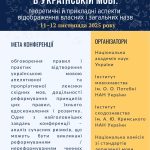
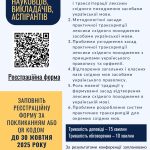
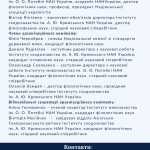
Наукова конференція «ЛЕКСИКА СХІДНОГО ПОХОДЖЕННЯ В УКРАЇНСЬКІЙ МОВІ: ТЕОРЕТИЧНІ Й ПРИКЛАДНІ АСПЕКТИ ВІДОБРАЖЕННЯ ВЛАСНИХ І ЗАГАЛЬНИХ НАЗВ»
How Ukraine Views Its Relations With China
China’s ever-closer ties with Russia have led to a marked deterioration in its engagement with Ukraine.
By Vita Golod and Dmytro Yefremov
The source: https://thediplomat.com/2025/09/how-ukraine-views-its-relations-with-china 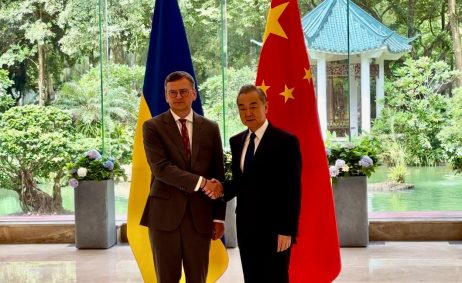
Ukraine’s ties with China remain anchored in a symbolic legacy: the $1.5 billion loan agreement signed in 2013 between the State Food and Grain Corporation of Ukraine and China’s Export-Import Bank. Just recently, Kyiv reaffirmed its state guarantee on the debt, under renegotiated terms that postpone repayment of both principal and interest. The move, signed by newly appointed Prime Minister Yulia Svyrydenko, was less about economics than about signaling a willingness to preserve what little remains of high-level contact with Beijing.
Yet beyond this gesture, the relationship is stagnant. Since Russia’s full-scale invasion in 2022, Ukraine’s President Volodymyr Zelenskyy and China’s top leader Xi Jinping have spoken only once, and interactions among officials, diplomats, and intellectual circles have largely dried up. Beijing’s disinterest was underscored this month, when Chinese Foreign Minister Wang Yi visited neighboring Poland but pointedly skipped neighboring Ukraine.
Meanwhile, Wang’s visit to Warsaw included high-level talks with Polish Foreign Minister Radosław Sikorski and President Karol Nawrocki. The omission of Ukraine underscored Beijing’s careful need to maintain dialogue with EU states like Poland while avoiding moves that might be read as distancing itself from Moscow.
In Kyiv, Poland’s experience in dealing with China is being studied closely. Both countries have signed a memorandum on the Belt and Road Initiative, yet Warsaw has reaped far greater benefits, securing tangible results well before the EU adopted its broader “de-risking” approach. But Wang’s visit showed that Poland and China remain fundamentally out of sync on strategic questions, with Warsaw emphasizing security and accountability in response to Russia’s war while Beijing avoids naming Moscow and maintains its posture as a neutral mediator.
Despite the political distance, China remains Ukraine’s largest trading partner. In 2024, bilateral trade reached $16.8 billion, heavily tilted in Beijing’s favor. Imports dominated – most notably $1.1 billion in drones and components for Ukraine’s army – while Ukrainian exports totaled just $2.4 billion, largely grain, sunflower oil, and iron ore.
Ironically, Ukraine’s Export Strategy 2030, announced in March 2025, assigns only a marginal role to China. Instead, it prioritizes alignment with the European Union and seeks to reduce the share of raw materials in exports to 59 percent, shifting toward higher value-added goods. While this transformation could, in theory, provide opportunities for Chinese firms to localize production in Ukraine, it has not yet materialized. Instead, European companies have already demonstrated strong readiness to move into this space with financing support – leaving limited room for Chinese investment.
Politically, the picture is far bleaker. China’s ever-closer ties with Russia have led to a marked deterioration in its engagement with Ukraine. Beijing has repeatedly defended this relationship, insisting that “normal cooperation between Chinese and Russian companies complies with WTO rules and market principles; it is not directed against third parties and should not be obstructed.”
Since the outset of Russia’s full-scale invasion, Beijing has drastically scaled back bilateral political dialogue with Ukraine, signaling its perception of Kyiv as lacking autonomous strategic weight. In stark contrast, China’s coordination with Moscow has become more systematic and frequent – developments that Kyiv views as direct security threats. Only in 2024, after Beijing effectively undermined Ukraine’s peace initiatives, did Zelenskyy shift toward a more pragmatic and instrumental approach to dealing with China, coupling it with sharper public criticism of Beijing. This adjustment was also shaped by broader geopolitical disarray following Donald Trump’s return to the U.S. presidency and the onset of a more isolationist U.S. foreign policy.
Despite this political chill, China has remained active in Ukraine’s economic landscape. Chinese Ambassador to Ukraine Ma Shengkun has sought to keep business channels open, promoting access for Ukrainian peas and aquaculture products to the Chinese market. The Ukrainian Chamber of Commerce has become the main venue for hosting Chinese delegations, which increasingly promote electric vehicles and consumer goods while exploring participation in postwar reconstruction. With ceasefire talks gaining momentum, the number of Chinese visits has grown significantly. Yet these have been limited to small- and medium-scale missions, not the large flagship projects once associated with the Belt and Road Initiative.
For Ukraine’s agrarian sector, China remains a priority market. A 2025 AgroPolit survey showed that 40 percent of respondents continue to identify China as critical for agricultural exports. Beijing could capitalize on this enduring interest by expanding access for Ukrainian products, as it has done for ASEAN countries. Yet access to the Chinese market has increasingly become politicized. Protocols for poultry and other goods have been blocked, and every instance of Ukrainian criticism of China has brought direct consequences for trade negotiations. In this sense, Beijing’s commercial leverage is viewed in Kyiv as a tool of geopolitical pressure, not as neutral economic cooperation.
Beyond the economic sphere, Ambassador Ma recently published an article in Interfax-Ukraine promoting China’s Global Governance Initiative, a concept launched by Xi Jinping at the Shanghai Cooperation Organization summit in Tianjin. The initiative, now a Chinese Communist Party priority, emphasizes sovereign equality, international law, multilateralism, and a human-centered approach, and policy effectiveness.
In Ukraine, China’s diplomatic messaging appears insincere, given the realities of the war and Beijing’s stance on it; it is seen less as neutral mediation than as an effort to shield Moscow from defeat or regime change. Abstract commitments and soft power strategies carry little weight as Beijing has failed to engage meaningfully with Ukraine’s public opinion and civil society, beyond elite diplomacy or economic deals.
Public opinion data reinforces this view. A survey conducted by Active Group jointly with Experts Club in August showed that 40.7 percent of Ukrainians have a negative view of China (30 percent mostly negative, 10.7 percent completely negative). Respondents cited China’s ambiguous foreign policy and perceived bias toward Russia as their primary concerns. There is widespread distrust of Beijing’s efforts to position itself as an international peace mediator. This skepticism constrains the Ukrainian leadership’s room for maneuver: any overtures toward China risk being seen domestically as accommodation to a state perceived as unfriendly, if not hostile.
Against this backdrop, Ukraine’s overriding priority remains national survival. Its integration with the European Union is best understood as a means to that end. This trajectory ensures that Kyiv will increasingly adopt EU standards and norms, including a gradual alignment of its approach to China with the broader European consensus. Across Europe, China’s assertive economic behavior has shifted the prevailing logic from cooperation to security-driven caution.
Future cooperation between Ukraine and China will remain possible – and, in some cases, even strategically desirable. Given recent restrictions on Ukrainian agricultural exports to the EU, China could serve as an outlet for surplus agri-exports, relieving pressure on European markets. Yet the challenge for Ukraine will be to develop this trade while avoiding excessive dependence on Beijing, which has repeatedly demonstrated its willingness to wield commerce as a political weapon.
Over the longer term, Ukraine’s Export Strategy 2030 reinforces this trajectory: by anchoring itself in the EU’s collective trade approach toward China, Kyiv hopes to safeguard its economic interests within the broader umbrella of European security and regulatory norms.
Shevchenko A. M. The economy of Budzhak in the Ottoman-Tatar period (late 15th – early 19th centuries)
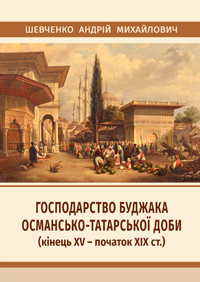
Shevchenko A. M. The economy of Budzhak in the Ottoman-Tatar period (late 15th – early 19th centuries). – Kamianets-Podilskyi: FOP Pankova A. S., 2024. – 96 p.: ill. (In ukrainian)
ISBN 978-617-7773-71-8
The popular science publication examines the main stages and features of the formation of the economic system of Budjak during its Ottoman-Tatar development (15th – early 19th centuries). The main attention is paid to the legal, economic, and resettlement aspects of the regional policy of the Ottoman state regarding the transformation of the region into a developed center of commodity cattle breeding and agriculture, which became one of the main suppliers of food to Istanbul. The features of commodity and semi-commodity relations in Budjak are determined, the historical, climatic, geopolitical, and ethnosocial factors that ensured the development of traditional industries for the region are traced, and the role of the cities of Budjak in the trade system of the Northern Black Sea region of that time is analyzed. Recommended for researchers, teachers, students, and everyone interested in the history of Budjak in the Islamic era.