


2026
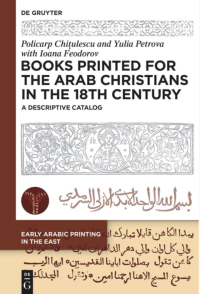
Books Printed for the Arab Christians in the 18th Century: A Descriptive Catalog
Policarp Chițulescu and Yulia Petrova
De Gruyter, 2026.
https://doi.org/10.1515/9783111036434.
Hardcover ISBN: 9783111036182.
eBook ISBN: 9783111036434
This catalog provides descriptive records of 54 Arabic books printed in Eastern Europe and the Arabic-speaking communities in the Ottoman East during the 18th century. It offers a thorough overview of the connections established through printing between the Romanian principalities and Arabic-speaking Christians in the eastern Mediterranean during this period. The catalog emphasizes the social progress that the printing culture brought to the Near East, to which Romanians made a significant contribution. The catalog also addresses the historical context of these connections and the printing activities of several prominent political and ecclesiastical figures. The books presented here are pivotal to the cultural history of the Ottoman East. They have been particularly significant in the context of conserving Byzantine-based Christianity in Arabic-speaking provinces in the region. Additionally, these books contributed to the standardization of Arabic liturgical texts and greatly influenced Christian Arabic literature. This catalog will be of interest to historians of the Arabic printed book, researchers of Arab Christian communities under Ottoman rule, as well as librarians and antiquarians because it will enable them to accurately identify and describe the 18th-century Arabic editions in their collections.
Printed book may be purchased at the publishing house De Gruyter Brill:↵
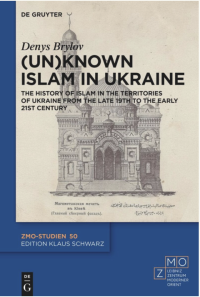
(Un)known Islam in Ukraine: The History of Islam in the Territories of Ukraine from the Late 19th to the Early 21th Century
Brylov, Denys
De Gruyter, 2026.
https://doi.org/10.1515/9783112225172
With the exception of the Crimean Tatars, the history of Islam in Ukraine, often remains unnoticed. However, traces of Muslim communities have been recorded since the 8th century. Based on materials from private and state archives, as well as interviews with representatives of Muslim communities and state bodies responsible for religious policy, the book reveals the previously unknown history of Muslim communities in Ukraine since the late nineteenth century: first as part of the Russian Empire, then the Soviet Union, and after 1991 in independent Ukraine. It analyzes how Muslims have preserved, transformed, and passed on their religious identity through formal, informal, and often underground structures.
The history of these communities shows that institutionalized Islam has existed in Ukraine since the late nineteenth century, even though after 1951 it was unofficial and even underground. In independent Ukraine, the institutionalization of Islam included the emergence of Volga Tatar communities from underground, the registration of Crimean Tatar communities returning from deportation, and the emergence of communities linked to transnational Sufi and Islamist networks.
Printed book may be purchased at the publishing house De Gruyter Brill:↵
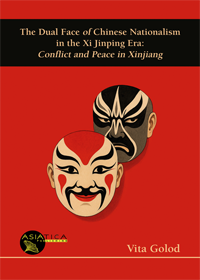
“The Dual Face of Chinese Nationalism in the Xi Jinping Era: Conflict and Peace in Xinjiang”
V. Golod
Kyiv: Publisher: Asiatica, 2026. — 430 p. ISBN: 978-617-8310-13-4
A monograph by Ukrainian China scholar Vita Golod, The Dual Face of Chinese Nationalism in the Xi Jinping Era: Conflict and Peace in Xinjiang, is now available.
The book offers a comprehensive analysis of contemporary Chinese nationalism as one of the key instruments of state governance and nation-building.
Drawing on academic literature, Chinese official sources, discourse analysis of Xi Jinping’s speeches, expert interviews, surveys, and the author’s field observations in Xinjiang, particularly in Kashgar, the monograph examines the interaction of ideology, economic policy, and ethnic governance in China under Xi Jinping.
Through the Uyghur case, the author conceptualizes Chinese nationalism as a phenomenon with “two faces”: integrative and civilizational on the one hand, disciplinary and assimilationist on the other. The book assesses the implications of this duality for stability, the unity of the “Chinese nation,” the transformation of ethnic minority identities, particularly Uyghur identity, and the prospects for peace in Xinjiang.
The table of contents and ordering information are available on the Oldi+ website.:↵